My outer-space adventure last year left me with an enduring sense of wonder — of hope, curiosity, and faith in the unknown.
“In spite of the odds, I’m glad you found me.”
“Same!”
Perhaps art is another way of discovering the unknown.
That thought followed me into the studio of my artist friend, Jonathan Nash Glynn, recently in Sag Harbor, NY, where his space paintings invite us to look outward and discover something deeper within. I had a rare chance to glimpse into his artistic world.
Jonathan doesn’t simply paint space; he dances on the canvas.
Inspired by imagery captured by the Hubble and Webb space telescopes, he created a series of massive space paintings, reimagining these celestial images through the language of Abstract Expressionism.
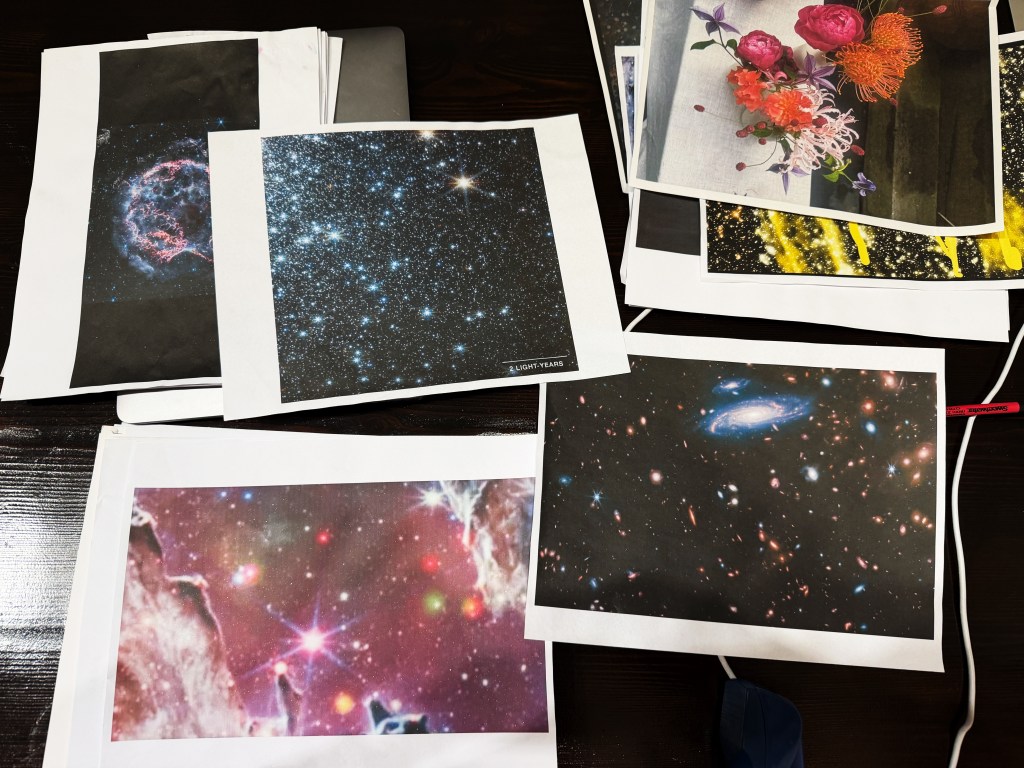
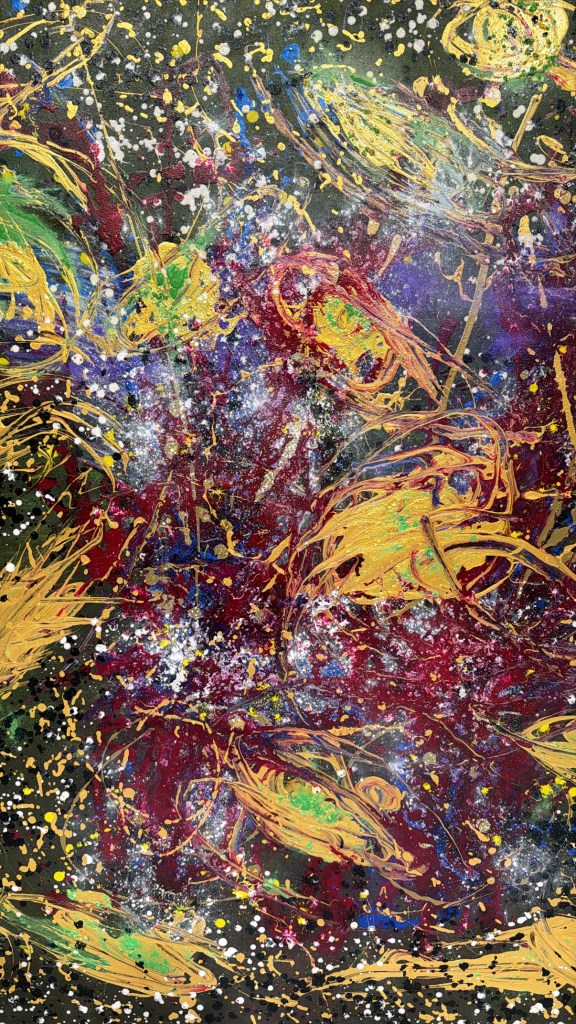
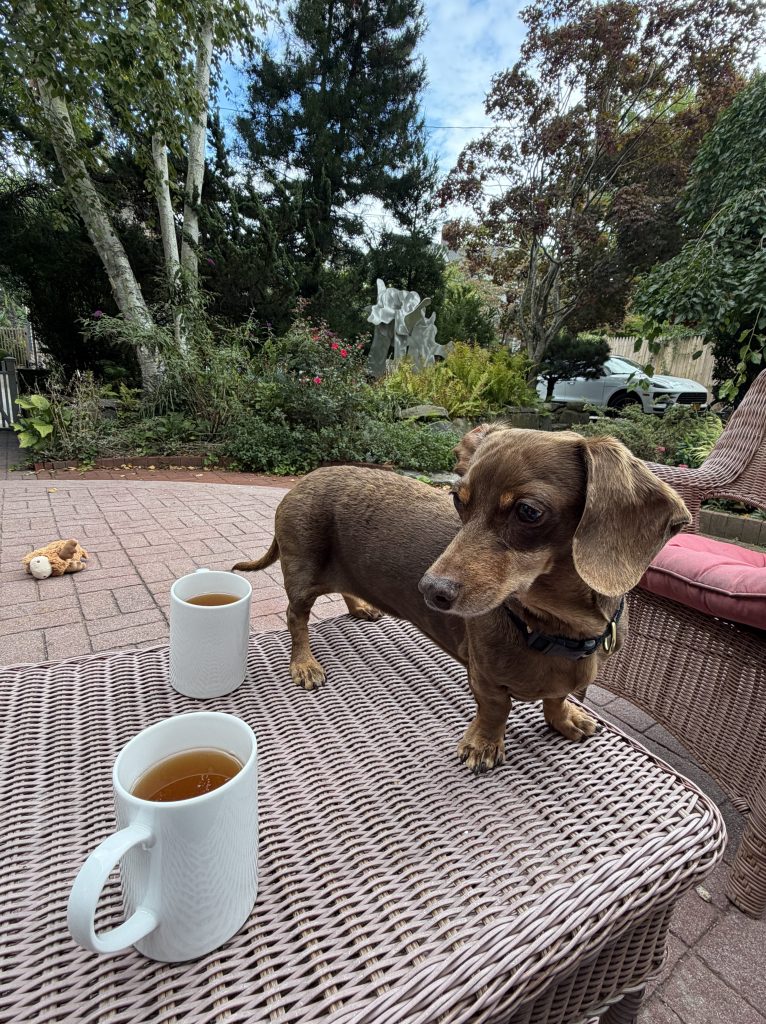
I stood in front of his paintings at his studio, works that had been exhibited at The Bridgehampton Museum last year, and my first impression was simply: WOW. Vibrant colors, irregular lines weaving into one another, and countless dots converging across the canvas. It truly felt as though the Milky Way had unfolded right before my eyes, with his beloved dog, Lolo, quietly by our side.
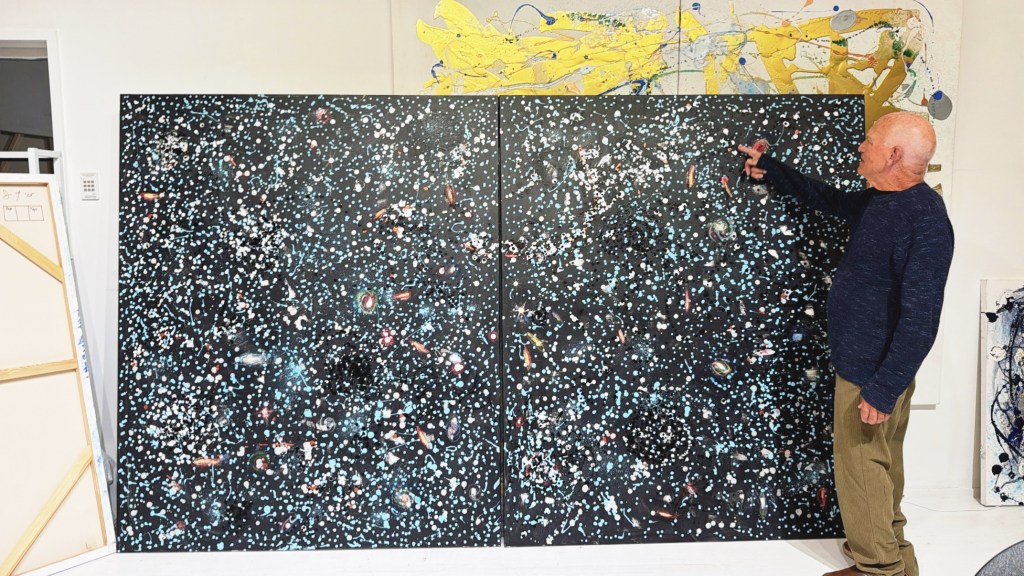
“I closed in on it, enlarged it, went deeper, to explore and create deeper within.”
Throughout the process, he follows his feelings and intuition, allowing each movement and gesture to emerge instinctively. He simply picks up the paint and lets it fall onto the canvas, responding to the moment and allowing the material to move freely across the surface.
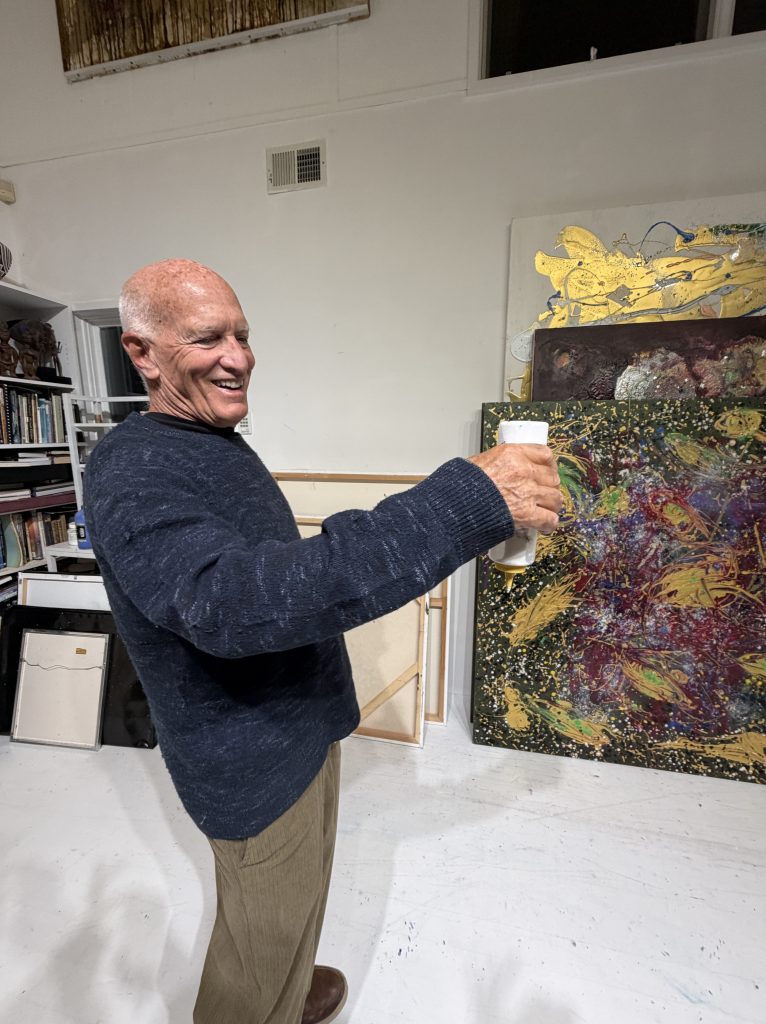
He moves through a terrain of matter and color, allowing the painting to assert itself through sheer physical presence. The surface ceases to be a support and becomes a field of energy, a painting that breathes, moves, and pulses with rhythm, its energy extending beyond the canvas and resonating with the larger energy of the universe.
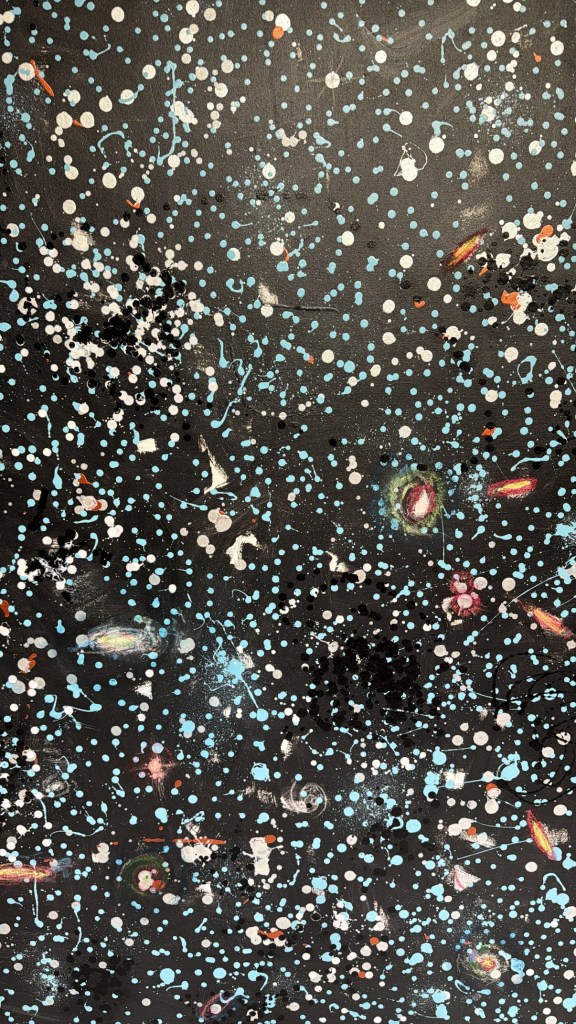
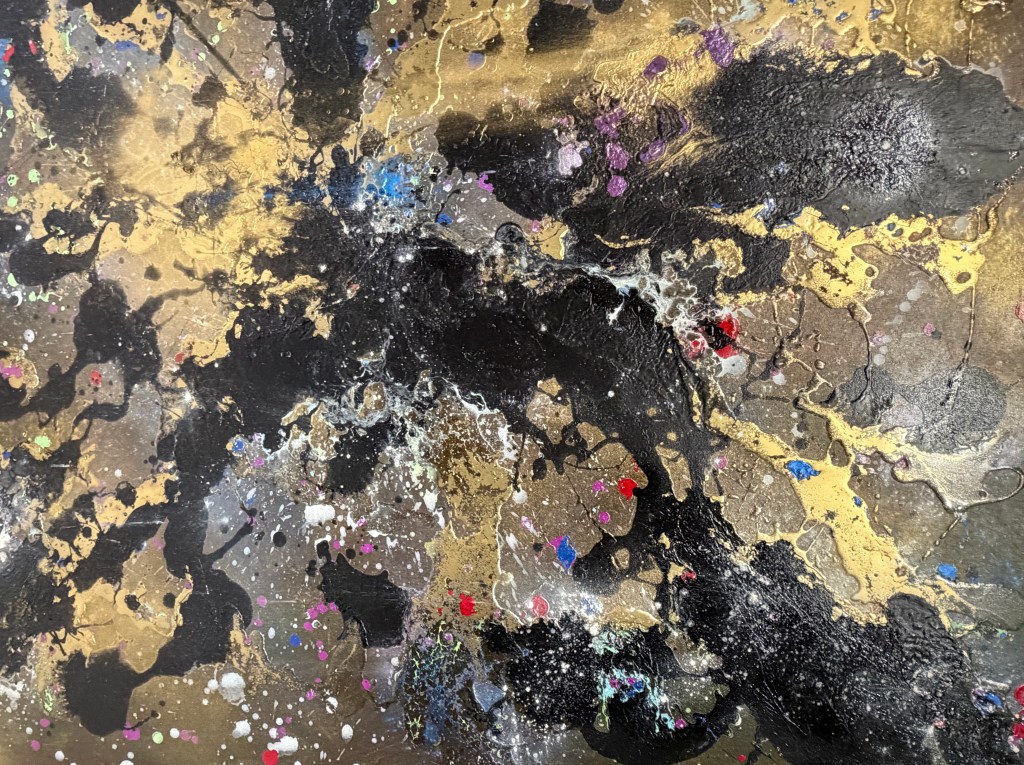
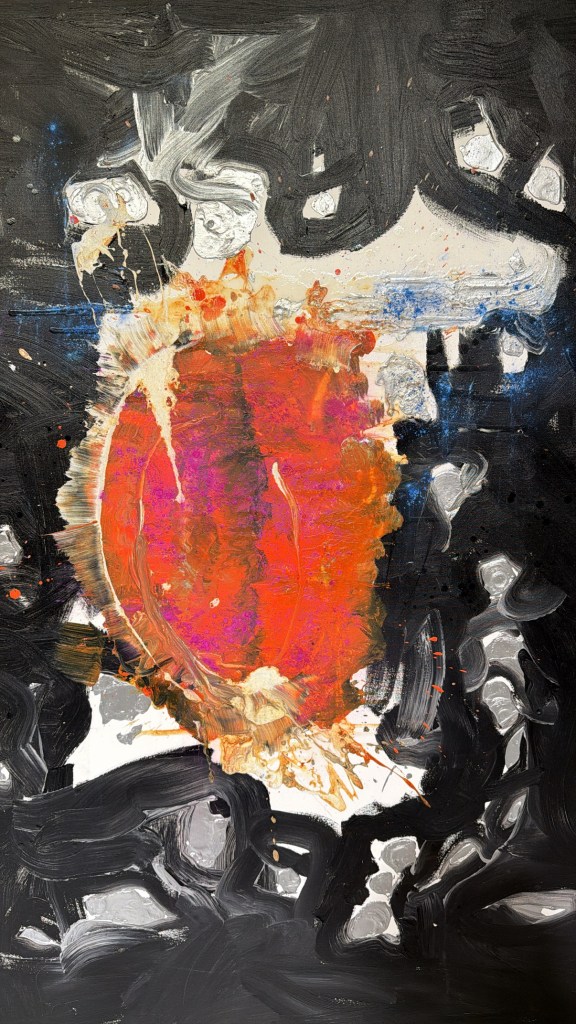
His physical engagement with the canvas reminds me of Jackson Pollock’s work, where gesture, movement, and the physical act of painting become inseparable from the work itself.
“When you paint, what do you feel you are connecting with, within yourself, with the world around you, or with something larger than yourself?” I asked.
“Perception. The whole world is magical. The galaxy created the stars, and human beings are such a small part of the universe. The creation of human beings is part of that same creative force. I think the galaxy and our own experience are connected through creation. I explore myself and reflect on the galaxy within,” he said.
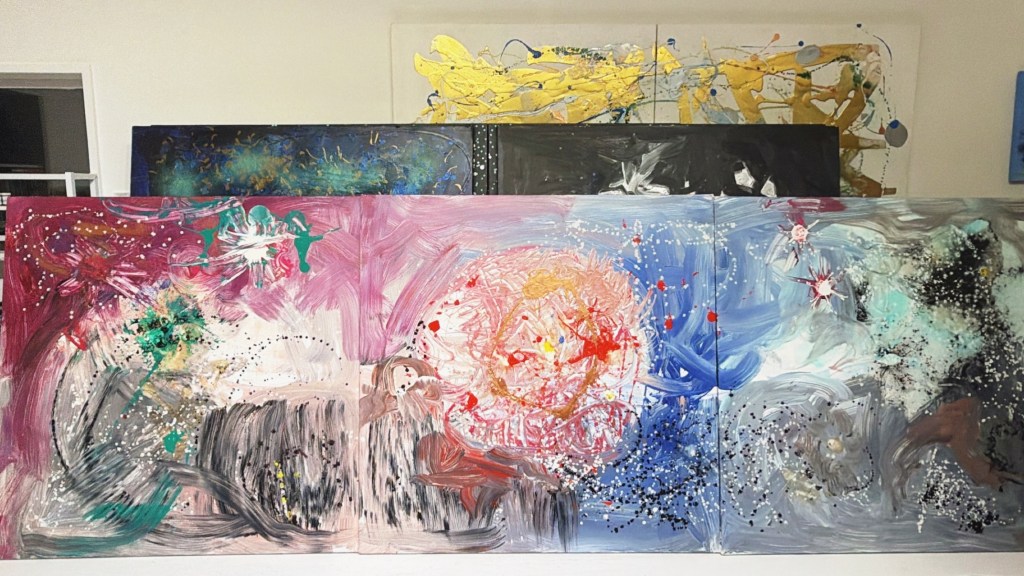
He then showed me a painting titled Creation, featuring a large, bright red and yellow celestial form. I immediately noticed its vivid colors. It felt as though the tiny point he had once pointed to in the vastness of the universe had been brought closer, enlarged, and transformed into a painting: a close-up view of something once distant and almost imperceptible.
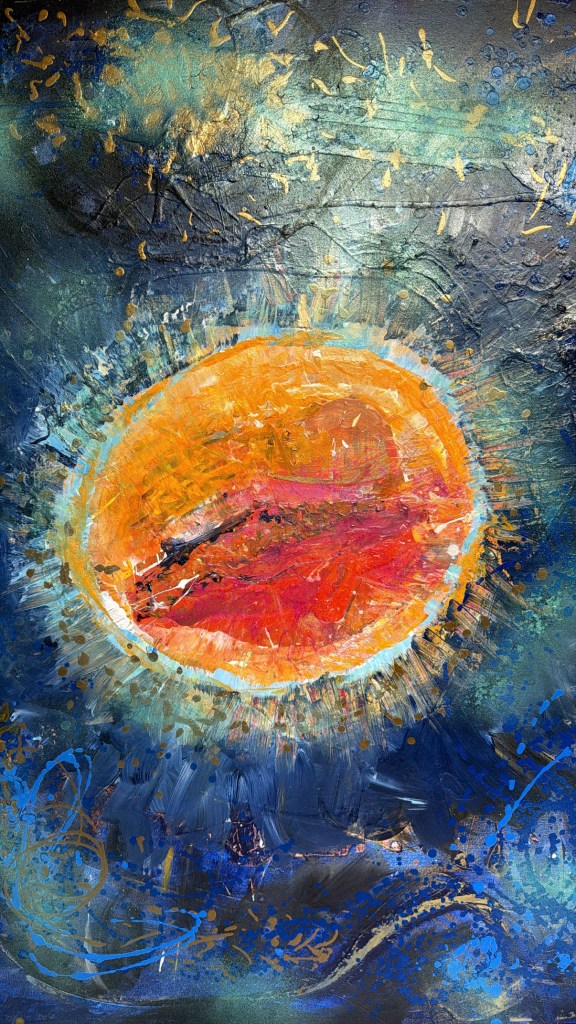
“It is one of my favorite creations. It connects me to the galaxy and its ability to create. The celestial form reminds me of a woman’s egg, holding the possibility of new life. It makes me think about the birth of human beings, the mystery of an individual life emerging from within. There is something magical about creation itself.”
In that moment, I felt the power and mystery of creation. Perhaps that is the power of this painting itself.
Our conversation continued as we moved through the private viewing.
Jonathan then showed me three individual paintings from his Symphony of the Cosmos series. Each panel revealed its own shifting range of color and atmosphere: soft pinks, deep blues, greens, and blacks, evoking luminous halos, depth, movement and energy.
The second panel evoked the explosive force of a vast celestial body, as if caught in the midst of a cosmic eruption. The third opened into an immense and boundless universe, filled with fantastical forms and countless stars. Each painting seemed to hold its own universe.
What was even more remarkable was that when the three individual panels were placed together, they formed an entirely new, monumental composition. Seeing them as one work made me feel once again the immense power of the cosmos.
“I don’t know what my paintings mean to other people, or what they mean to you. What did you feel when you looked at my paintings? What did you see? That experience is what makes a painting successful.”
He smiled. It stayed with me. A painting does not end with the artist; it comes alive through the person standing before it.
I then asked, “What is the biggest difference between your past and current work?”
He answered, “It is a transition. In the past, I made figurative work and relied more on ideas. Now, I work with more freedom, intuition, and fluidity. I let the painting evolve. I open up and let go of control. These paintings are about freeing myself and creating work that is like a jazz composition. I always know that there is a certain violence, a certain inner violence in me that just doesn’t want to make a pretty picture for its own sake.
Last year, I was standing in the middle of these space paintings at New Space. The show was special. I feel lucky to have had the opportunity to complete these works,” He added.
New Space was the first exhibition in The Bridgehampton Museum’s new Tractor Barn.
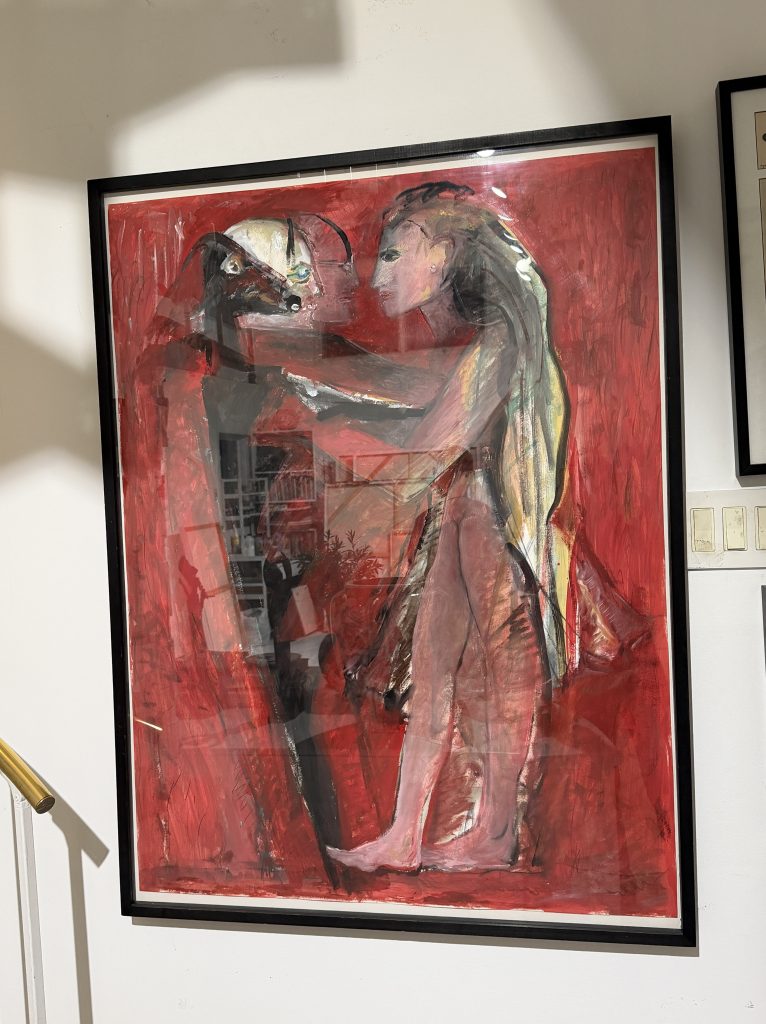
He shared that he admires Pablo Picasso for having his own vision and for continually forging new paths throughout his career. What he finds most compelling is Picasso’s ability to influence generations of artists while constantly challenging conventions.
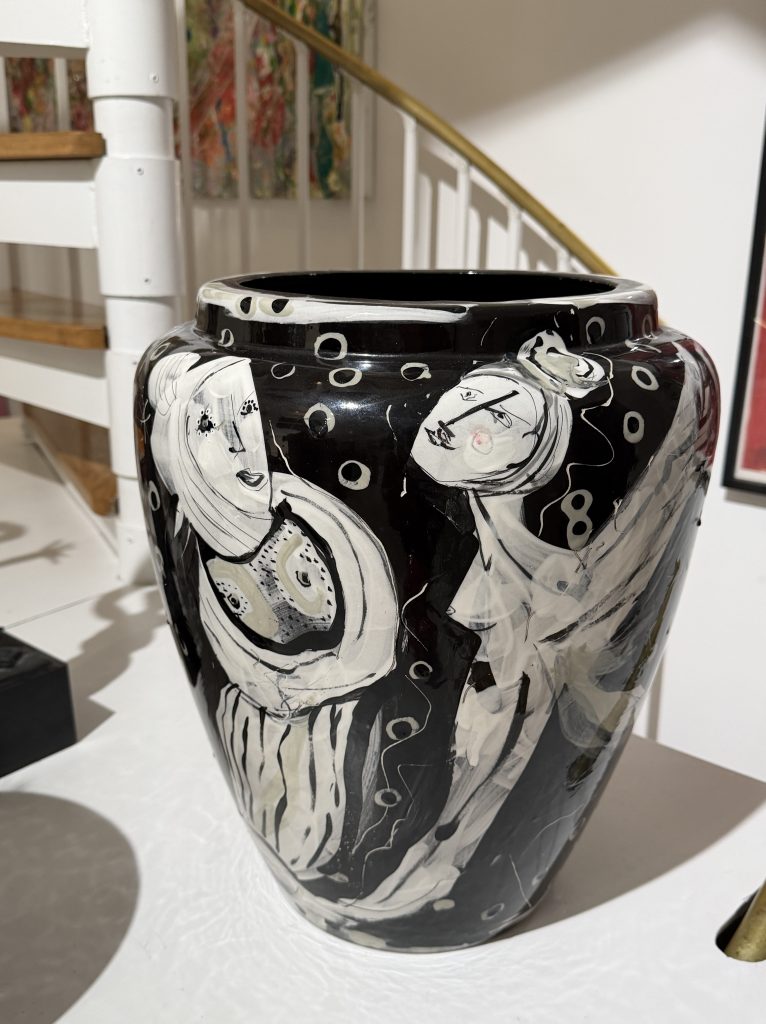
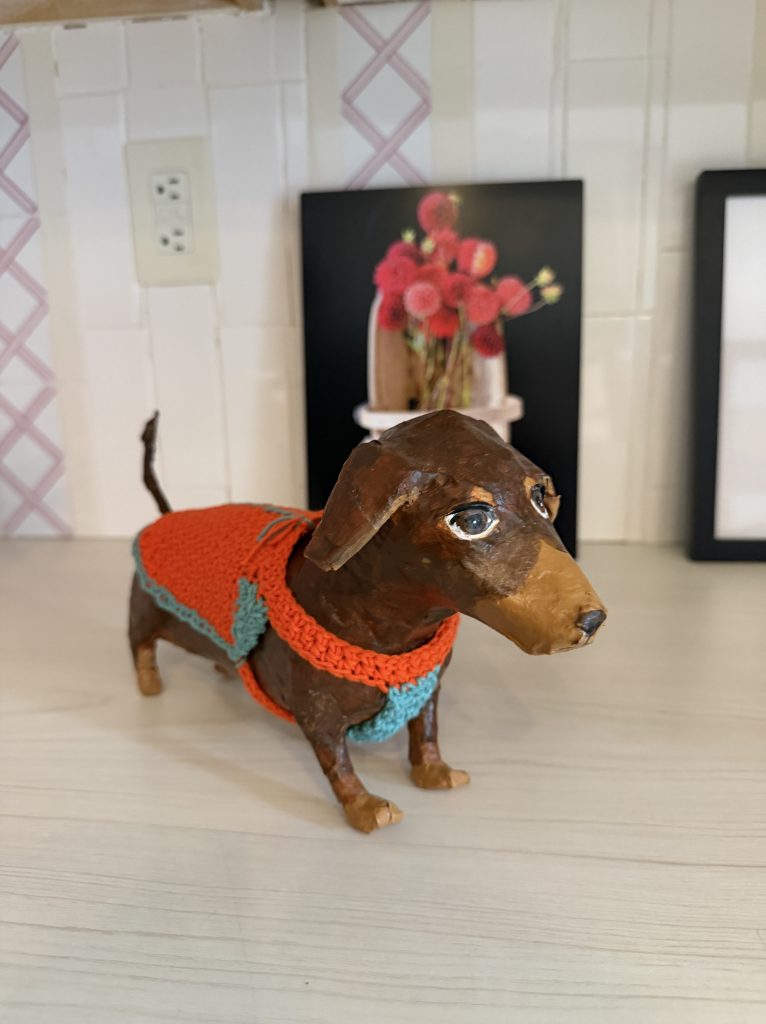
Beyond the canvas, his artistic expression can be found throughout his home. Ceramics he has painted are scattered around the house; each one created purely through intuition. He told me that when he paints on them, he simply follows his feeling and lets the forms emerge freely.
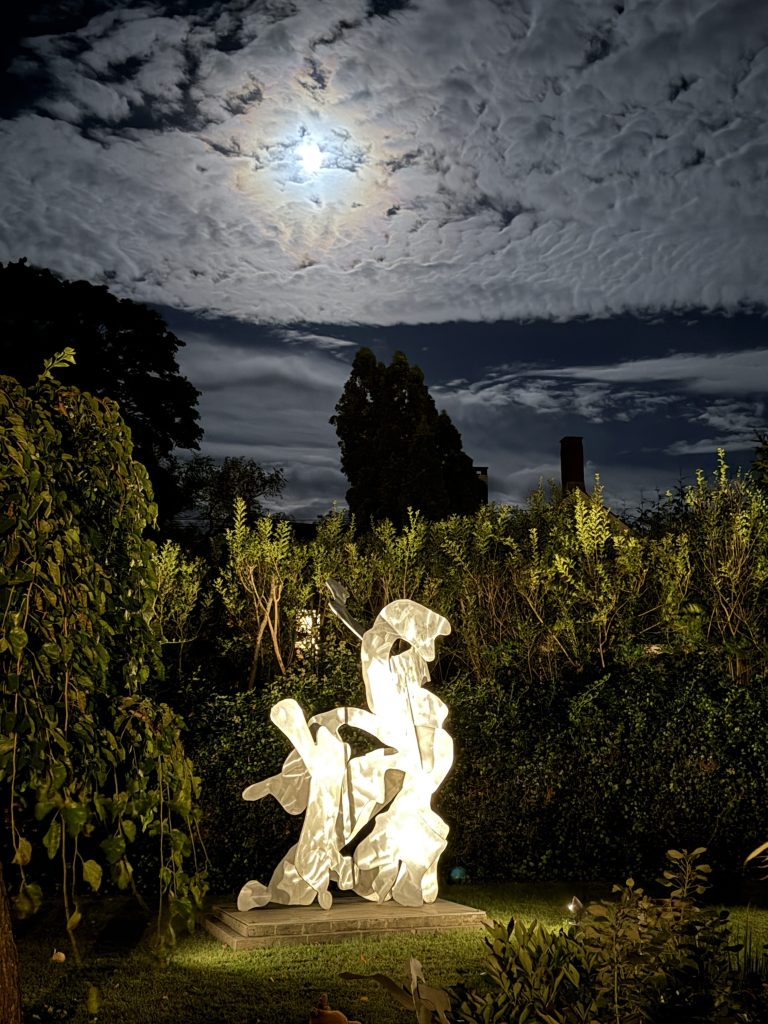
His sculptures are scattered throughout the grounds, becoming part of the landscape. Especially at night, under a full moon, the quiet surroundings and soft light reflecting across their surface seem to bring them to life. I found myself appreciating yet another dimension of this multifaceted artist: his ability to move freely between painting, objects and sculpture.
From the Sky to Haiti
Jonathan’s journey extends beyond his art.
He is also the founder of Wings Over Haiti on the East End. Following the devastating 2010 earthquake, he flew his small plane to Haiti, delivering medical supplies and aid to remote communities where larger relief efforts could not reach. What began as a personal mission grew into an organization dedicated to supporting communities in Haiti.
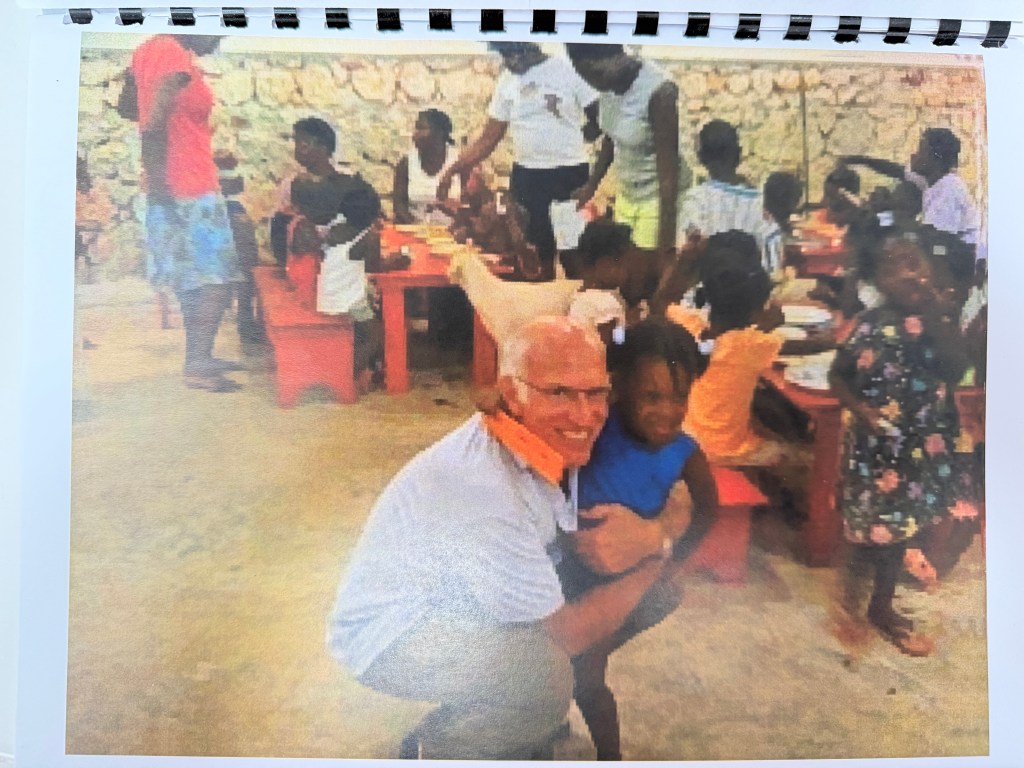
Today, Wings Over Haiti hosts fundraising events with Hamptons artists and support two schools serving more than 300 children, with the hope of helping them pursue higher education, and, ultimately, giving them the opportunity to soar.
Fun fact: Thirteen years ago, Jonathan flew all the way to North Carolina to bring his beloved dog, Lolo, home. What an amazing adventure! Although he no longer flies today, that spirit of adventure continues to shape his life and his art. He keeps exploring the unknown and venturing beyond the familiar.
Between the Stars and Self
Before I returned to the city, we had dinner at Jonathan’s home and shared our journeys and thoughts on collecting art, how a painting takes on a new life when it becomes part of someone’s everyday world.
What stayed with me most was his commitment to making art on his own terms, to remaining true to himself while continuing to evolve and explore. In his space paintings, he looks outward into the vastness of the universe, yet at the same time, he looks inward, exploring himself through the act of creation.
Perhaps that is what makes his work so compelling: somewhere between the stars and the self, he continues to search, to discover, and to evolve, not only as an artist, but as a person.

If you’d like to discover more of Jonathan’s work, please visit his website .


Leave a Reply